Category: Classic
Vortex draws me back to the 80s
In 1974, physicist Stephen Hawking thought that a black hole might not really be a vortex of nothingness. He said in the mess at its centre, charged particles – which would normally be together – could become separated, with one beyond the event horizon, and the other swirling around just outside. This faint glow in the vortex was dubbed “Hawking radiation” and experts are still arguing over whether it exists, after his death.
In early 2018, I found myself facing a Hawking moment, with cars. I had long wanted to own a 1980s Subaru Vortex, with its wedge shape, asymmetrical steering wheel and fighter jet dashboard.
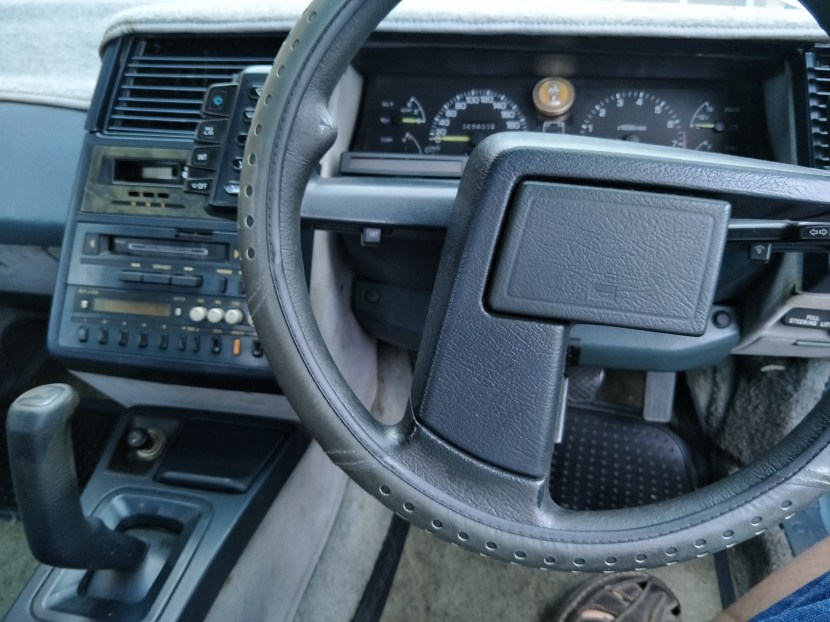
Incidentally, the Vortex was only known as a Vortex in Australia and New Zealand. In the U.S. it was simply an XT, but for Japan it was the Alcyone: that’s the central and largest star of the Pleiades constellation, which makes up the Subaru logo.
When a blue 1985 Vortex came up on Gumtree nearby, needing some engine work, I pounced on it and bought it from an old couple for a few hundred dollars. The husband was almost blind, so they were downsizing to just one car. Their Vortex’s 1.8 litre EA82 engine had started leaking coolant one morning as they backed out, so it stayed in the garage and went up for sale after a mechanic said (on the phone, mind you) that it could be the water pump. The old man got teary as I had it towed away.
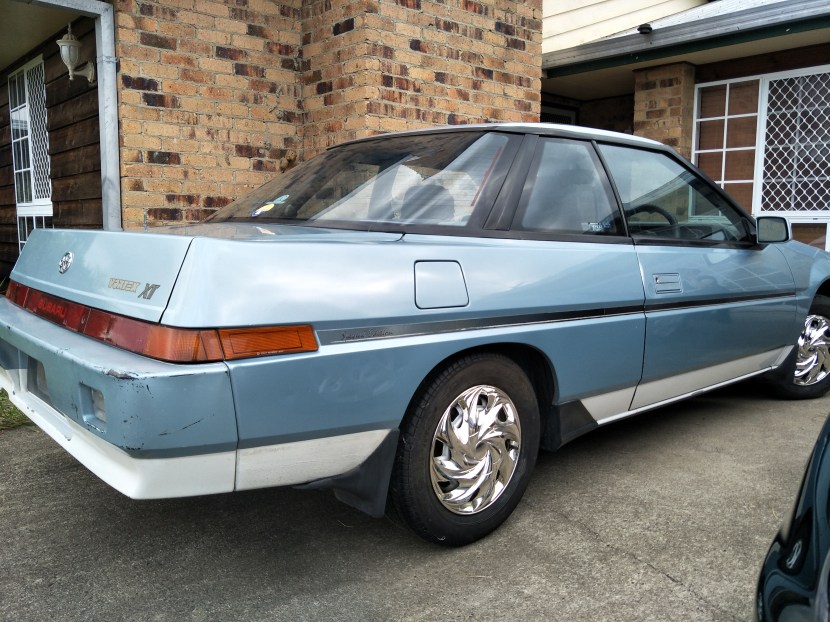
For a 33-year-old car, it wasn’t too bad: it had some minor scratches and dents, some rust around the boot welds, sunroof and front chassis rail, and it needed some attention to the paint/clear coat. But it also had something I wasn’t keen on: shiny auto store hubcaps. The original hubcap was a very 80s blocky “graph paper” design, with a flat surface for aerodynamics, so as the engine was brought back to life and the rust and paint was done, I went looking for those hubcaps.
Gumtree provided me with a very nice one in Brisbane from a parts car, but I needed another 3. That’s when I rang a fellow on the Sunshine Coast, about his ad for all types of Vortex parts. He said on the phone he should be able to “dig up” his hubcaps, which no-one had wanted for many years.
I arrived at his place (a farm being turned into a housing estate) and he showed me 2 hubcaps, covered in soil and rusty around the wheel rim clamps. I don’t think he was joking when he said he would dig them up! I bought them, and as I left he mentioned that he had to vacate his farm soon, and he had a “complete” automatic Vortex in the shed, along with a car shell. “Make an offer for both,” he said. He’d salvaged some parts off the silver shell for his own car, and had bought the White Vortex in Brisbane in 2010 – driving it home to his shed, where it stayed.

I thought I might be able to use the shell to fix the rusted chassis rail in mine, so with my wife’s permission I later made him an offer for the complete car and the shell. It was a cheap price – towing them home would cost about as much as buying them – but he was moving off the farm in just a few weeks, and needed them gone.
The day I went to pick up my “accidental” Vortex purchase, it was not long after a week of heavy rain, so we had to use his tractor to get the 2 cars up a hill to the tow truck.

On closer inspection, the white car had more rust than mine, damage to the front bumper, and dirty wet carpet. It would need a good clean, once the tow truck brought it home.
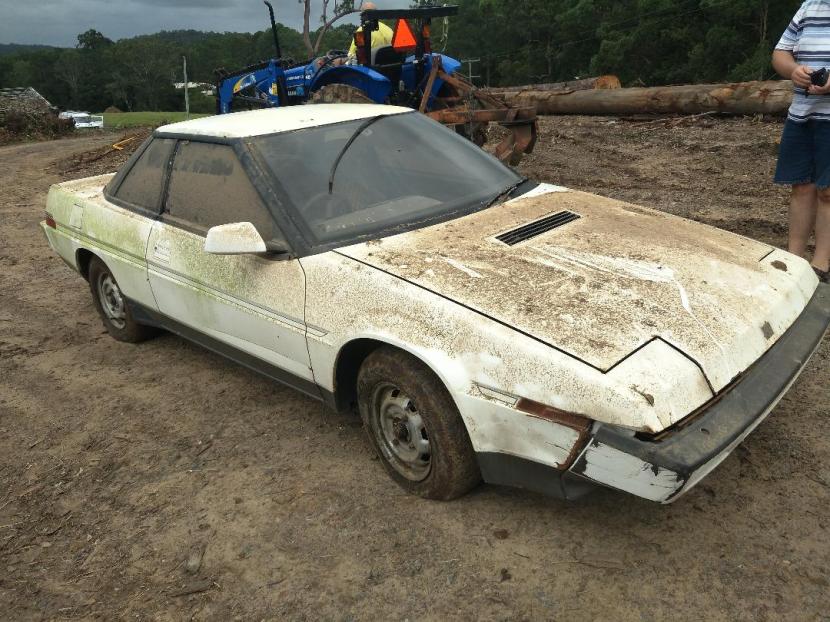
On my lawn at home, it became clear that the white Vortex was an unusual purchase: it had “TURBO” written on the dashboard speedo – along with an air intake on the bonnet – but no turbo in the engine bay. However, there was a suspicious hole in the exhaust line going from the engine, which was probably for the exhaust gas “dump” from the turbo. I reckon the old man had harvested the turbo from this Vortex, for his own car.
As well, this Vortex was made in mid-1985 (some months earlier than mine), had no sunroof, but did have a JDM-style wiper/washer on the back window. It had a ‘height’ button on the dash, but no air suspension. It had a 4WD button between the seats, but was front-wheel-drive only. It even had a different font for the Vortex badge.

There was some talk in online forums about how 1980s Subaru executives brought out some cars from Japan early to show off to dealers, before the official on-sale date. Was this White model the first (or one of the first) Vortex cars in Australia? Subaru Australia didn’t have any information, and Subaru Japan never got back to my Facebook message.
I did find an old bank card in the car, with a woman’s unusual name on it. I Googled her name, found her number and texted her: she was the owner who’d sold it to the old man in 2010. Her mum owned a restaurant, and had bought the Vortex off the original owner, who was a regular customer there. However, she couldn’t help with any more history.

There was one more surprise with this car: when I opened up the boot, there were 4 hubcaps stacked in there. So I could now fit out my own car, with a couple to spare (of varying quality). My mechanic got the white Vortex running (rough) one day, after a lot of encouragement, but we didn’t put it into gear: I simply wanted to see if it would start.
With my Vortex now back from the body shop, and the longitudinal front-wheel-drive boxer engine running fine after a rusted-though coolant pipe was replaced, it was time to get it registered. Plus, the Vortex shell had been cut up by the body shop for me to keep the spare panels and glass. I didn’t want to do up another car.. so I put the white Vortex online to sell, for a few hundred dollars.
I had offers for bits of the car (I believe the rear disc brakes are popular for upgrading the Subaru Brumby from its drum brakes) but I didn’t want to have a car in pieces on the lawn. Eventually, a local car detailer offered to buy it, at a hefty discount, and arranged to get a tow truck to pick it up. His wife had seen the car advertised, liked the look of it and wanted to get it going. The husband wasn’t a fan, but they towed it away anyway.
A couple of weeks later, the call went out on a Subaru forum for an un-cracked dashboard for the white Vortex – they’re dubbed “unicorns” by owners, as they’re so rare. So I’m guessing that call went nowhere. Then a week or so later, the white Vortex was up for sale on Gumtree – initially for more than I was paid, then it was reduced, and then it disappeared.
So for me, the white car went into a black hole.. but my blue Vortex is still shimmering like that Hawking radiation – in theory at least.
Watch the YouTube walkaround here

Hand built by robots: Proton Gen.2
English singer-songwriter Newton Faulkner had striking ginger dreadlocks and a top 10 hit on his hands in 2007, when he released the percussive guitar-driven “Dream Catch Me” from his album “Hand Built By Robots”. It’s been voted one of the top 100 songs of the 2000s.
Newton Faulkner – Dream Catch Me
Because the song was such a hit, he had to become a robot: rushing the last few tracks of his debut album, in just a few weeks. The album title has stayed in my mind, because of the idea of robots “hand building” something.
In the 2000s, Malaysian car maker Proton was using robots, to put together about 60% of each car it made. It had built a new factory, to make the Waja sedan, and the Gen.2 hatchback (which were similar under the skin). Both were imported into Australia, but strangely enough the $27,990 Waja didn’t sell well. However, the sub-$20,000 Gen.2 did, and it started to appear on streets from late 2004. Its headlights were apparently inspired by a tiger’s eyes. I liked the look of the Gen.2.

I was wasting time on eBay in 2012, when I saw a manual orange 2007 Gen.2 offered for $2,300 unregistered, at a Nambour car dealer. A 5-year-old car (with aircon, central locking and alloys) for $2,300!? The ’07 model was selling used for around $5,000, registered. You might think “what’s wrong with it?”, but I knew the dealer wanted this trade-in gone because it was an unknown model to have to resell. To be fair though, it did need new tyres.. and the push-down door lock replaced on a rear door. Proton parts weren’t found anywhere near Nambour.
I’d changed jobs the year before and still had some funds from my unused holiday payout, so I was able to talk my wife into letting me buy it – and driving me up to get it. With the dealer paid and a Transport Department permit obtained, I drove it home.
Proton launched in Australia in the mid-90s, selling copied Mitsubishi designs as a “Wira” with the slogan “People go on and on about Proton”. However, despite a million kilometre warranty (yep, you read it right – but only over 3 years) not many people went on about them – or bought them in those early days.
At around the same time, Proton bought a majority stake in British sports car maker Lotus, and had them help create new models – one of which was the Gen.2. Driving home in my orange buy, I could feel the Lotus influence on the handling (a lot of fun to drive, very tight on the road), but I could also hear the road rumble due to lack of soundproofing, and see the cheapness of the seating and interior plastic.

It looked very funky, with aircon controls stacked on 3 dials at the bottom of the dash, a sporty steering wheel, and an analogue clock at the top. However if you ran your fingers over the dash, door trim and steering wheel, it had all the roughness of very used Tupperware – and none of the flexibility. Plus, the driver’s seat might have been built by the Flat Earth Society – it was like sitting on a hard park bench, leaving you hanging on for dear life while going around a corner. So it handled well, but you’d be brave to demonstrate that.

With 4 new tyres and (after some weeks of waiting) a new lock for the back door from a dealer near me, the Gen.2 was registered and used as my second car. I eventually put it online to sell, and a young lady (not all that local) bought it for a handy profit – this time.
Incredibly, not long after I sold it, this car built by robots was stalking me like The Terminator. One morning as I drove into the city along a very western route (to avoid the traffic of the main one), a blob of orange appeared in my rear vision mirror: it was the Gen.2, being driven by the young lady who’d bought it off me.
My dream (sale) did catch me.
Little Pug became White Elephant
The term “white elephant” – meaning something you can’t get rid of, even though it’s costing you money – comes from the tradition of kings in southeast Asia keeping white elephants as a show of power and prosperity.
They occasionally gave a gift of a white elephant, which was seen as both a blessing and a curse. While it was an honour to receive the gift, the sacred animals couldn’t be put to work and were expensive to maintain.
Even circus legend and “The Greatest Showman” P.T. Barnum ended up with his own white elephant – literally and figuratively. After spending a huge amount of money to get one from the King of Siam, he discovered his “white elephant” was in fact grey, with pink spots.
And in mid-2016 I ended up with one on my driveway – in the form of a 2003 Peugeot 206.
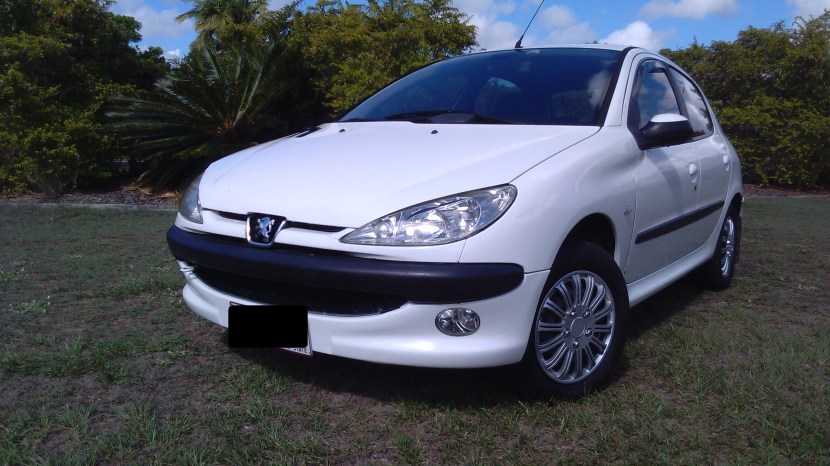
My daughter was after a more modern car to replace her first ride, and (unfortunately) I spotted this unregistered French hatchback on Gumtree, for $800. So we went to Caloundra to look at it.
A number of internal alarm bells went off for me during the inspection – starting with the man selling it (“Pat” the laid-back muso was a bit vague on the history of the car, saying his son had been driving it, and he assured me its bad clutch was a characteristic of Peugeots). The Pug needed plenty more work: it had a damaged front passenger panel from a “minor” bingle, worn tyres, plus no spare tyre – or even a gearstick top. Despite my repeated warnings about the cost of repair, my (adult) daughter maintained her interest in buying it. My wife (who later dubbed it the white elephant) says she would have simply dragged her away from the place!
Just before we handed over the cash, I asked my daughter to do a federal government PPSR search on the car with her phone: this would check whether the car was stolen or written-off. After spending $3 and waiting a minute, the website came back, saying the Pug wasn’t stolen. So money was exchanged and she drove the car home on a permit.
The next day we took a closer look at the PPSR certificate, seeing this:

This was the bit she hadn’t seen, further down her phone screen – that the Pug had been written off 2 years earlier following an accident, but it was “repairable” damage. However after any repairs, the car would still need a “written-off vehicle inspection” (WOVI), costing close to $450.
I rang Pat, and accused him of selling a dodgy car. He claimed he didn’t know about it being written-off, and he’d been given the Pug to settle a debt. However he couldn’t remember the name of the person who’d handed it over. I told him he should refund my daughter, but he said the money had already been spent on “music equipment”. In the end, it was our word against his, and I would spell out what happened in a Statutory Declaration at the written-off inspection.
A mechanic took a look at the car and said while it ran well, the chassis crash repair looked like a backyard job, and the clutch was too far gone – so both would need to be sorted before getting the Pug registered.
My daughter now didn’t want the car, and planned to sell it – as a write-off – for a few hundred dollars. However I foolishly told her I’d pay her a few hundred for it, and get it fixed for myself.
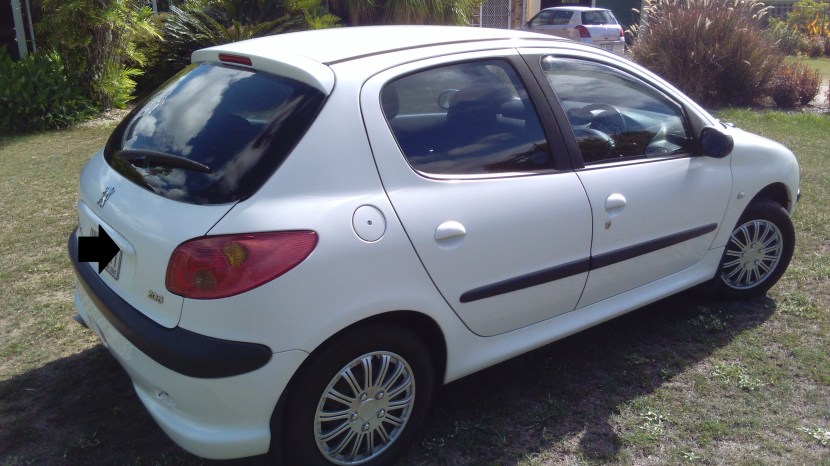
After $450 chassis work at the panel beaters, 4 new tyres, a spare wheel found at the wreckers and a whopping $2,000 on a new clutch and front suspension, the Pug was ready for the written-off WOVI inspection – which it easily passed in early 2017.
It drove very well and spritely with the 1.6 litre engine, plus it sat securely on the road like the VW-based cars I’d owned in the past. The air conditioning worked a treat. It even featured automatic headlights and rain-sensing wipers.

However, it wasn’t a car I’d wanted to own – and it had caused me hip pocket pain.
So after driving it for a while, it went on the net for sale – initially for what it owed me, then at a more realistic price. Once the price was lowered just before Christmas, I had more than a dozen buyers asking about it. A couple looking for a spare car made an offer, and I accepted.
I wasn’t sad to see the Pug drive off: like P.T. Barnum’s own white elephant, mine was also a dirty grey colour from sitting out in the weather, and just as much of a money pit.
Colt of old regret
Sam Colt founded a firearms company in the mid-1800s, and nearly 30 years later released his most famous revolver for the US Army: known as the .45 or, incredibly, the “Peacemaker”.
A little over a century on from that, Mitsubishi Motors Australia used its newly-acquired Chrysler plant in South Australia to produce a local version of the Japanese Mirage, as a Colt. It had a 1.4 or 1.6 litre 4-cylinder engine, with a bonnet that hinged at the front, not near the windscreen. Even when new, the Colt was a little ‘old skool’: it didn’t have fuel injection – it still had a carburetor – and this feature would come back to bite me.
My introduction to the car came in 2003, when a radio colleague was selling her 1988 manual brownie-bronzie one.

By Jeremy from Sydney, Australia – Mitsubishi Colt RB GL, CC BY 2.0, https://commons.wikimedia.org/w/index.php?curid=38109719
It had been her grandmother’s – then hers – but with a newer vehicle on the way, she offered it to me, unregistered, at the trade-in price she’d been offered: $500. Gran had sideswiped a garage door, so there was a minor dent on one wheel arch and some surface rust spots on the bonnet. Interestingly, the Colt had rotating “satellite” buttons on either side of the steering wheel, for the lights and wipers.

At the time I was driving a SEAT and my wife owned a big late-90s Mitsubishi Magna wagon, which would soon be needing some major engine repairs. So a plan was hatched: sell the Magna, give her the SEAT, and I would drive the Colt.
With the Colt registered, I cleaned the Magna engine and took it to a local caryard, which paid me a little over $2,000 for it. So I was already ahead by a grand or so!
About the same time, I was offered a TV job in Sydney. I’d move down there, rent a room, and fly home on weekends (these were the days of $29 Virgin Blue flights, which I bought in bulk).
So at dawn sometime around mid-May 2003, I packed some clothes, bedding, a plastic table and a stereo into the Colt, and drove south to new opportunities.
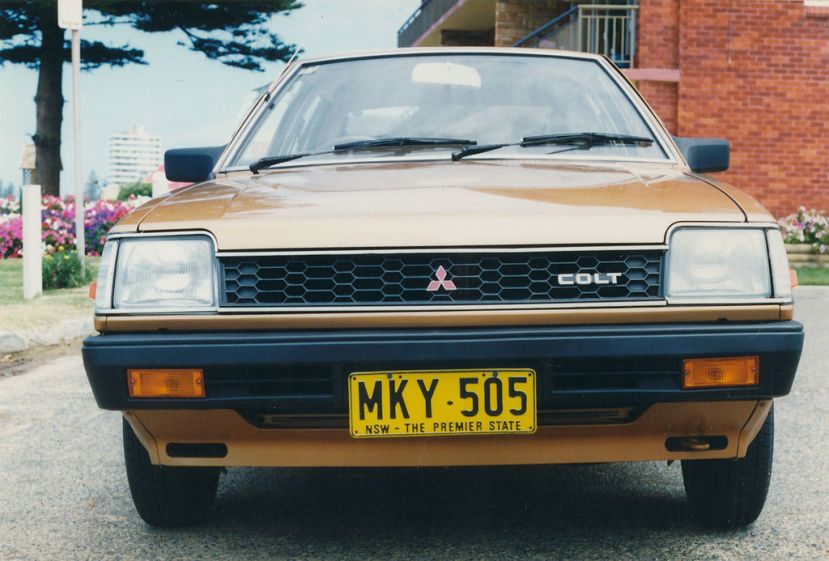
By Jeremy from Sydney, Australia – Mitsubishi Colt RB GL, CC BY 2.0, https://commons.wikimedia.org/w/index.php?curid=38109720
I arrived in Sydney at dusk, then bought some milk and cereal at a supermarket, and checked into a room – at an upmarket outer suburbs hotel – that had been arranged by my new employer, until I found a place to rent. The Colt was parked underground in the carpark.
The next morning, I ate my cereal out of a coffee cup with a teaspoon, and went down to the Colt. I turned the key, and the engine turned over, but wouldn’t fire up. I tried again and again. Eventually I called the NRMA, hoping that they would cover an RACQ member – which they did.
After just a couple of minutes, the mechanic had the car going, and asked “before you start the car, do you kick the accelerator pedal?”. With a fuel injected car like the SEAT, you didn’t even need to hit the pedal as it started, let alone before.
I later discovered that pushing the accelerator before starting a carby car resets the choke within the carb, getting it ready to cut back on air intake to make the fuel mixture richer for easy cold starting.
I believe the mechanic mentioned the butterfly valve in the carby could get stuck fast by a vacuum, on repeated starting attempts. I think he said the cooler weather in Sydney might have also had something to do with that (I’d had no starting problems in Brisbane).
He pointed out that in the owner’s manual, it does say to fully push the accelerator, before turning the key. I don’t think my Colt had the owner’s manual.

The Colt was fine to drive around Sydney, and leave at the airport every weekend. Although one Sunday, driving back from the airport – through the uphill section of the Harbour Tunnel – the car starting ticking or “pinging” badly (pre-igniting fuel), and losing power. I made it out OK, but then had some repair work done.
Before too long, the Colt was gone. My wife had been driving the SEAT, but with 2 young kids in tow she longed for rear doors on a car, instead of just 2 doors and front seats that had to be folded forward to put kids in the back. So during some holiday time I drove the Colt back to Brisbane, prepared the SEAT for the trip to Sydney, and traded the Colt in on a big 1990s Saab 9000 CS for the wife. With the Colt gone, I was the peacemaker.
The Monster Mash
If you tell someone to think of Frankenstein, they might visualise a large, murky-skinned body made up of parts, with a couple of bolts hanging off it. The classic Hollywood version is easy to imagine – even if it’s not factually correct. Mary Shelley never named the creature in her story – Frankenstein was the name of the doctor who created him.
It’s a similar process to how the Land Rover Discovery I used to own became known as “The Monster” – and it was also a body made up of parts, with the odd bolt hanging off it.

I’d been looking for a Land Rover 4WD when a mechanic friend found this 1996 7-seater Discovery 1, via eBay, in Bundaberg. One Saturday, late in 2013, we drove 4 hours north to look at it. The Disco had a worn manual gearbox, that protested loudly as we took it for a test drive. It also had some rust spots, but great air conditioning and a good 300 Tdi diesel engine, that had had some work done to the head recently. With a promise that the gearbox would be replaced with a reconditioned one at cost, I bought the Disco for $1600.
It still had a couple of days’ Victorian registration on it, and the owner was happy for us to drive it home. So the long trip south began – I drove the mechanic’s Disco home, and he drove mine – keeping the gearbox in 4th gear as much as possible, as it produced the least noise (due to a 1:1 drive ratio in 4th).
On arrival at home, my wife dubbed it “The Monster”, thinking I’d find it a derogatory term. I didn’t think it was monstrous at all – I loved the name and it stuck.
With “The Monster” now at home, plans were hatched to change the 1000kg gearbox ourselves, in my garage. The mechanic would do the work, and I would “assist” (i.e. grab spanners for him). It wasn’t long before we started this monumental job, one weekend.
After many, many bolts were undone, the old gearbox was freed from the vehicle, and hit the floor with a gigantic thud. The reconditioned gearbox was then moved underneath, but was too heavy for us to move up and into place, using jacks, bricks and firewood logs. So, on another day we borrowed a workshop crane, to do the job properly.

Crane pulling the gearbox up from within the cabin
After only a little swearing over the unwillingness of the new gearbox to move into place, the job was done and the truck could drive quietly.
However it did wait quite a few months to be finished off enough to pass a roadworthy. Now, I had my own off-road transport- and it was quite capable.

Land Cruiser Park river crossing
Underneath, the Discovery is very similar to the Land Rover Defender, has constant all-wheel-drive and a centre differential lock to make those low range gears even more grabby with the wheels. The diesel is very economical – while the V8 engine is only economical when compared to, say, a jumbo jet. That’s why they’re even more of a bargain.
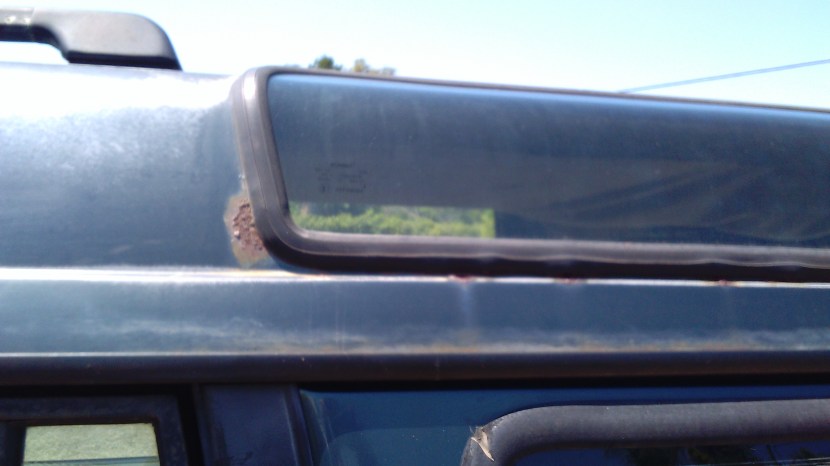
Mine suffered all the usual problems of a nearly 20-year-old Disco – rust around the Alpine windows in the roof, peeling clear coat from the bonnet paint, sagging roof lining, sagging seats – even the digital clock barely worked. However the engine kept clattering away happily, and it wasn’t my everyday drive.
After a couple years of ownership, with my wife driving my car each day, I decided that I now wanted a 4WD as my everyday drive, and a more luxurious one at that. So I decided to sell “The Monster” and bought a Range Rover.
It took 10 months, and a lot of price falls, before I found a buyer. I initially thought that a reliable – albeit rusty, ugly and old – diesel 4WD would fetch a lot more than it did. It sold, for slightly more than I paid, to a local man, who was going to take the engine out of it to fix up his own Discovery.
So just like Frankenstein’s monster, my Monster was ending up in pieces.. Although my experience had been more of a Monster Mash, than a graveyard smash.
Lantra with a mantra
The 1960s hit song “The Little Old Lady (from Pasadena)” was apparently inspired by used car salesmen in California, who would tell prospective buyers that a car was “owned by a little old lady from Pasadena, who only drove it to church on Sundays”.
They weren’t always telling a fib, with plenty of religious couples from America’s Midwest moving further west to Pasadena to escape the 1930s Dust Bowl and Great Depression, and leaving a cared-for car in the garage – for much of the week – in their retirement years.
I’d not long moved north for my first paid radio job, when my parents traded their 1985 Mitsubishi Magna in on an automatic 1991 Hyundai Lantra dealer demo. The first-generation Magna had done well, but had some issues – and Hyundai was getting noticed for its cheap prices, and the rising quality of its cars.
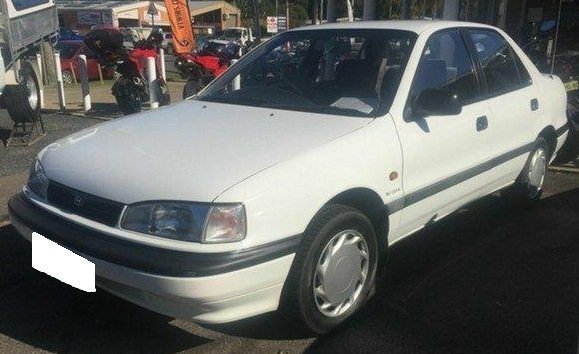
A similar Lantra
On a weekend visit home, I somehow talked them into letting me take this nearly new car for a drive – along with 3 of my friends. We opened the garage door, and laughed: the registration plate on the car said 123-BLO. By chance we all immediately counted together, then blew out simultaneously. It was nice to drive a car, with that “new” smell.

The Lantra at a local carpark after it was sold
The mid-sized Lantra had clean lines, painted bumpers, velour seats, air conditioning and power windows. Power locks were also included, and so was an intermittent problem with them, that was never able to be fixed. But there was one thing missing from the car: the letter ‘E’.
In plenty of overseas markets at the time, it was sold as the Elantra (and it is now sold as that here). However because Hyundai was getting Mitsubishi’s help with its designs in the early 90s – and Mitsubishi had a Magna model on sale at the time, called the Elante – it was decided that the Hyundai car would drop the ‘E’ and just be a Lantra.
The Lantra was mum’s car, and for years it did indeed do little more than a shopping trip once a week, and a drive to church on Sundays. It was fine for her, but anyone else driving it would notice the complete lack of power from the 1.6-litre engine, unless you pushed the pedal to the floor. It was so underpowered, Hyundai offered a 1.8 engine for the 1992 model.
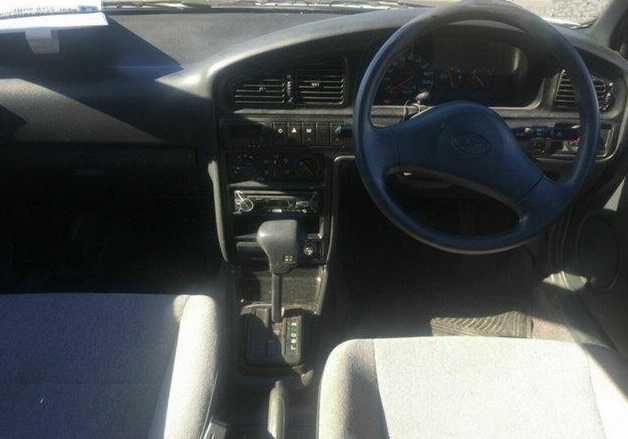
Our Lantra had a maroon interior
After around 15 years of ownership – and with the odometer nowhere near 100,000 kms – a newer car, being sold by a neighbour, tempted mum to move the Lantra on. At first it went to my future sister-in-law, who drove it to the train station, but by late 2009 it was back on the market – and the odometer reading of just 102,000 kms meant I couldn’t let it go.
So I brought the Lantra home (the 5-seater shared the garage with the 2-seat Smart), and it had been used so little, it still seemed to have a “new car” smell. It happily did the school run for over a year.
Once I decided to sell it, I had it serviced – but a week later I noticed it was low on oil. I asked the mechanic about it, and it turned out that although the Lantra’s engine was barely used, parts inside it had deteriorated and (at highway speeds) were allowing some oil to sneak out the exhaust. So the engine would need an overhaul at some stage.
A young local mechanic eventually bought the Lantra for his lady, then I heard it was sold (unregistered) to a new owner, who still drives it around the local area. He’s a little old man, and I can’t say for sure what the car does on Sundays.
The Boy in the Bubble
Seinfeld was into season 4 when it aired an episode called “The Bubble Boy” in October 1992. It followed Jerry’s attempt to meet a fan – a boy in a bubble – and how it all went wrong, when George arrived early and decided to play Trivial Pursuit with him. When George asks the rude and selfish boy “who invaded Spain in the 8th century?” he answers: “the Moors”. That’s when a wry smile crosses George’s face, and he reveals the (misprinted) correct answer on the card is “Moops”. The boy is left deflated, in more ways than one.
By strange coincidence, late 1992 is when I began shopping for a car they call “the bubble”. I’d seen the “new” Mazda 121 advertised on TV, and it looked like a fun small car to own.

The ad ended with the man washing the car having a bucket of water tipped on him from an upstairs balcony by a curly-haired woman – but despite the thought of my then-girlfriend doing the same to me (I lived in a high-rise unit) I still wanted one.
At the time I was driving a late 80s Daihatsu Charade and earning OK money from my first job, so buying new was the go. There was just one thing I wanted my 121 to have, that I’d seen on some others – a boomerang-shaped spoiler on the boot.
The curvy Mazda 121 was a huge success in Australia. In Japan, it was sold as the Autozam Revue (Autozam being a Mazda brand at the time). It had a peppy 1.3 litre engine, plus air conditioning and power steering as standard. But power windows? Forget it. The seats and armrests were covered in strange but colourful squiggles.
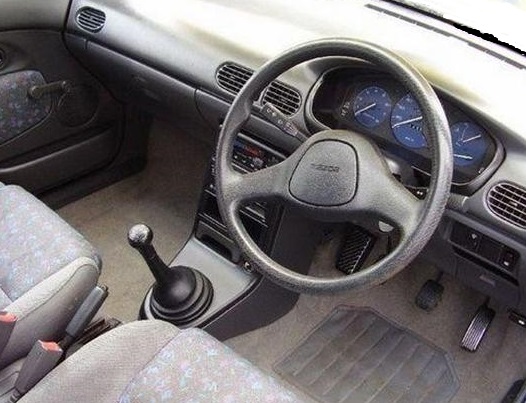
The boot pivoted open very cleverly, and the designer supposedly said it was based on a woman’s behind. But even all that couldn’t save it. It wasn’t very popular in other countries, and was killed off by the time the Asian Economic Crisis hit in 1997. Australia was then treated to the “boxy” and more conventional 121 Metro.
To the Mazda dealer in Gladstone, I would have been a gift. One afternoon I walked in and told them I was interested in buying a dark blue 121, but it had to have a spoiler on the back. The salesman told me they didn’t have a dark blue one, but a mid-blue one had just finished a run as a demo car: it had headlight and bonnet protectors, and (wouldn’t you know it) a spoiler on the boot.
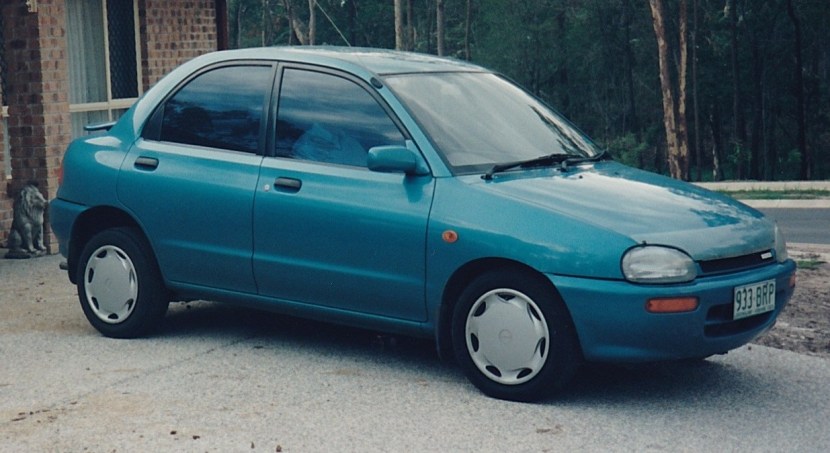
He took me out the back, to where the “Canaipa Blue” car was getting a wash and vacuum. Once the staff had finished with it, we took it for a drive and I was sold: it was a perky 4-cylinder to steer, and had fabric-covered seats instead of plastic ones.
It was time to talk turkey – and I’m ashamed to say I was a little caught up in buying my first new car. They offered me a trade-in on the Charade, and then the balance through the dealer’s own finance company. I didn’t say yes straight away, so then they offered me a phone to call someone about the deal. So I called home (an expensive STD call at the time). Mum answered, and the best she could manage on short notice was “I don’t know, whatever you think is best.”
So I thought it was best to take the deal. It was a pleasure to own for the next 3 years, apart from tinny metal on the doors (resulting in minor carpark denting) and paint being easily scratched. That’s probably why the car came with a tin of touch-up paint in the glovebox.
With its air-conditioning and sure-footedness, the “bubble” was a handy car to own for the 6-hour Bruce Highway drive back to Brisbane on weekends.
For me, the purchase had been no trivial pursuit, and there were no Moops.
Mighty long wait for a Mighty Boy
In 1980s Queensland, you could only get your learner’s permit at 17, but you could try for your licence just six weeks later. So on my 17th birthday, I got my mum to drive me to the local police station, where I answered five questions and received my learner’s permit, typed up on cardboard.
I already knew how to drive – at 12, Dad had let me take his 1960s manual Toyota Corona around the local showgrounds (until the groundsman told us to leave). However I did take a couple of lessons with a driving instructor, mainly so when I turned up for the practical test in the driving school car, the official would see I’d had some “professional” instruction.
Six weeks to the day after my 17th birthday, I got my licence. That was after a close call during the test, where an ambulance, with lights and sirens on, burst out at me in the middle of an intersection. I initially hesitated to stop, but thankfully hit the brakes just as the tester did the same on his set of pedals in the passenger side.
So I couldn’t wait to get my licence – and that was partly because of the car I used to walk past each morning at high school, after parking my bicycle.

It was a Suzuki Mighty Boy – a red one – that I think one of the Manual Arts teachers owned.
Suzuki was a small car specialist in the 70s and 80s, getting noticed here for its tiny but very willing 4x4s, and also offering a cheap new car to Aussie buyers: the Suzuki “Hatch”. In 1985, it began importing a small utility called the Mighty Boy, which started out as a 2+2 sports car (the Suzuki Cervo) with the back seats and back roof/hatch removed. If you look under the parcel shelf behind the 2 seats in a Mighty Boy, you’ll see the footwells in the floor, for rear passengers in the 4-seat Cervo.
The Mighty Boy was a “Kei” class car in Japan – limited in size and engine capacity, to suit the streets of Tokyo. Apart from Japan, it was only ever sold in Australia and Cyprus.
Watch a 1986 Mighty Boy TV ad here
I’d seen Mighty Boys advertised new for under $7,000 at Zupps, which was way more than I could afford. However I knew I wanted one, even if the 543cc engine – and the car – were ridiculously tiny.
8 months after getting my licence, I used my Coles paypackets to buy my first car, a yellow Toyota Corolla for $3,000 or so.. which would ultimately prove to be a bad purchase.
Over the years I kept my eye on Mighty Boys – I tried to buy one I saw driving past in the 90s, but couldn’t afford the asking price. However, thanks to the internet, eBay was now telling me when it found them – and one day in 2013 it found what became known as the Mighty Smurf:
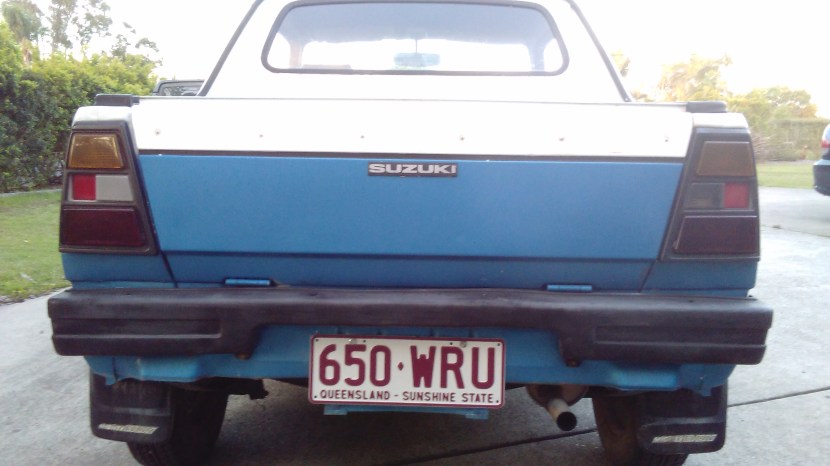
It was up for auction – or “buy it now” for $800. This 1986 model had a blown head gasket on an exchange 800cc F8B engine from the Hatch/Alto, but was otherwise in reasonable condition, with a bizarre two-tone “backyard” paint job.
The one thing it had that I didn’t really want, was an automatic gearbox. However, after a quick discussion with my wife, I pressed “buy it now” and set about hiring a trailer, and hiring Dad to tow it.
I didn’t check for the usual body issues with Mighty Boys: rust in the firewall seam and cracked strut tops. I was just happy to own one for a few hundred dollars. As it turned out, the car was reasonably good on both issues.
It didn’t have the chrome rails on the roof and around the bed. Instead, it had tiny truck-style lights installed in the roof.
With the Mighty Boy at home, I rolled it off the trailer – and discovered the brakes didn’t work at all. I just missed another car on the driveway, and steered into the garden to come to a stop. This tiny car was already turning into a bigger project than I had anticipated.
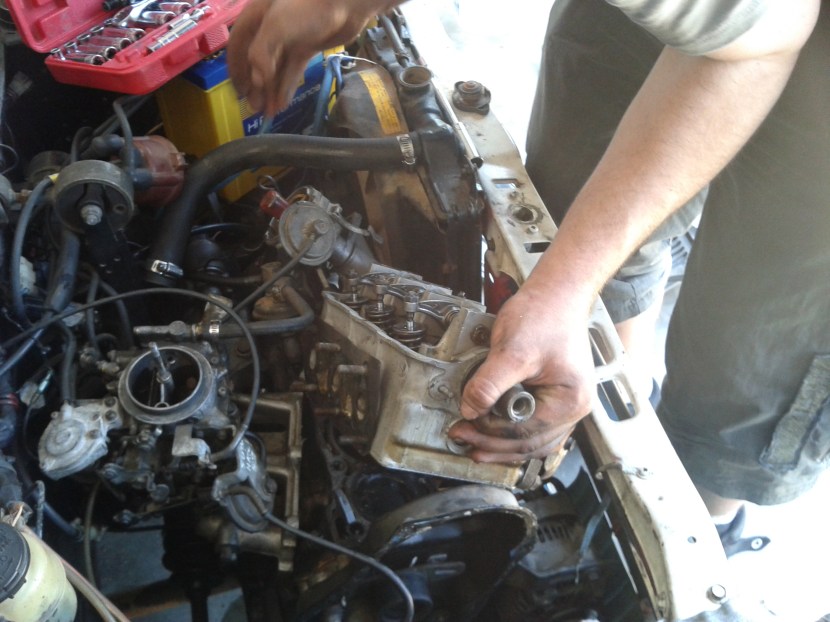
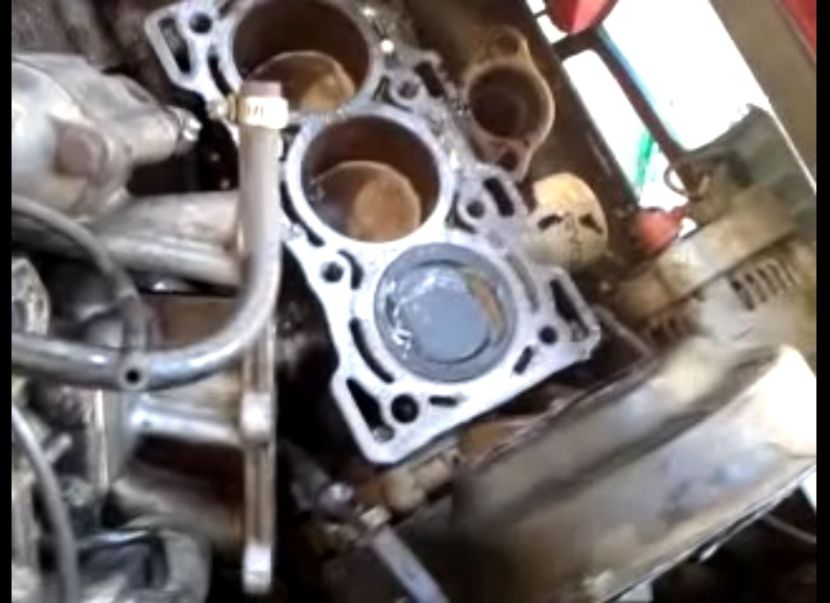
A mechanic friend replaced the head gasket at home, to get the engine running again, but it took over a year to have the car ready for the road (it needed everything from a new driveshaft to seat vinyl repair). In early 2015, the Mighty Boy was registered, and scooting around with its 2-speed gearbox (yep, just 2 speeds) prompting a busy hum in the engine. It was low to the ground and my head was close to the roof, but it was great to steer quickly. My 1980s dream had been fulfilled.
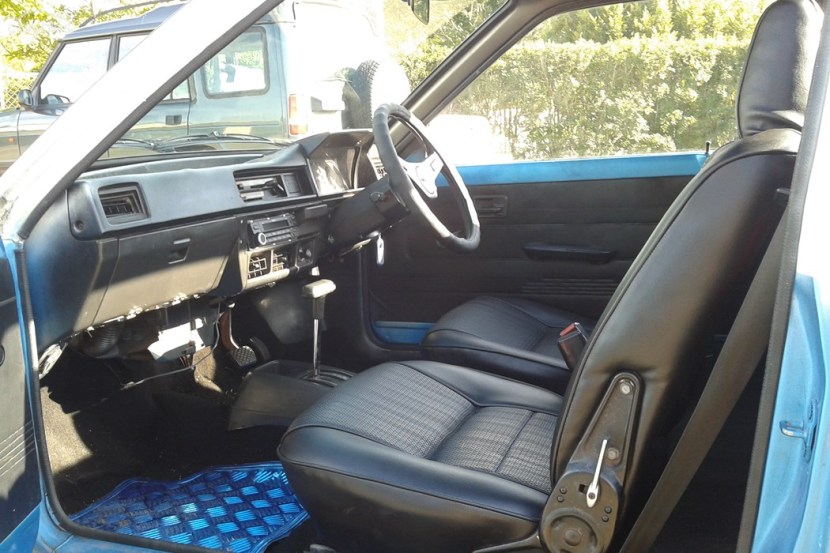
See the overspray on the side of the dash!
It certainly got noticed – a friend of my daughter posted a picture of it at the local shops on Snapchat, with a comment along the lines of “OMG I’ve never seen such a tiny car!”. That prompted my daughter to let her know it was her Dad’s car.
The seats are seen as lacking in side support, and they’re usually also bent back a bit from use. Plenty of people put in other smallish seats, with better bolstering.
Inside, the glovebox lid often needs securing at the bottom, where there’s just a plastic seam. Mine had hinges screwed in.
After a year or so, I’d had my fun and it was time to recoup some of the money I’d put into it. I advertised the car in 2016, prompting a former owner to contact me, to explain that she’d painted it blue and white to resemble an esky.
It took a year to find a buyer who’d pay the price I wanted – it was a young mechanic with plans to repaint it and give it a new engine.
I’d buy another Mighty Boy – a manual – for the right price. Look me up in another 30 years.
POSTSCRIPT: It didn’t take 30 years – about 5 years after putting the Mighty Smurf up for sale, I bought a yellow manual Mighty Boy, called Daisy.
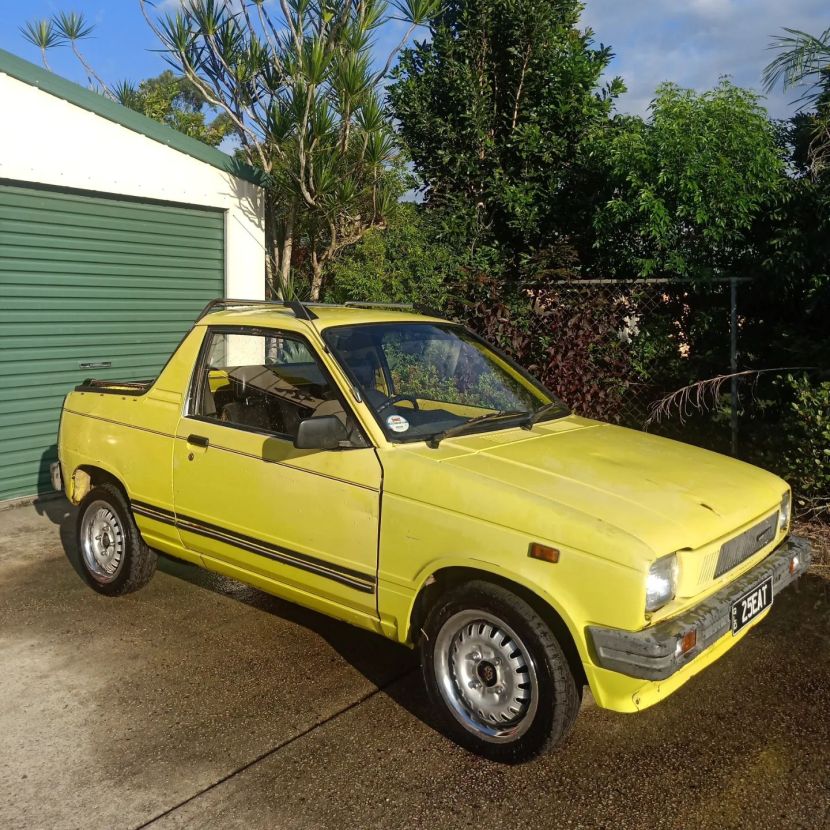
Watch the intro video here
Charade love was the real thing
In late December 1991, Mikhail Gorbachev resigned from his job, as President of the USSR. At that time, I was just about ready to resign from my job: doing phone surveys, like Newspoll, into the night. That’s because I was also getting up at 5:00 each morning, to work for free at a community radio station, 45 minutes’ drive away. I’d finished uni during “the recession we had to have”, and hadn’t found full-time journalism work. So the split shifts meant I was tired. Perhaps that’s why on New Year’s Eve ’91 I decided to get involved in a charade – a Daihatsu Charade. This car would eventually bring me and my future wife together.
It’s a brave car company that names its dependable little runabout “Charade”, but Daihatsu did that for over 20 years. The Cambridge Dictionary says a charade is “an act or event that is clearly false”. The truth is, the car was a good Japanese product at a bargain price.
For some reason, I was driving my second car (a 1981 Mazda 323) through Kedron in Brisbane, when a dark metallic shape on the corner of the Byrne Ford caryard caught my eye. My 323 was a good car, but it was using a little oil and just starting to show rust spots in the doors – so I suppose I was looking for a replacement I could afford – just not that seriously.
If I’d had the money, I would have bought a Niki but I was still only making casual wages, so I couldn’t afford a new car. The Charade was a dark grey 3-door, only a few years old, and I’m pretty sure it was just under $6,000. With my trade-in I could afford that!
I got talking to a salesman, went for a test drive, and loved the peppy “thrum” of the 3-cylinder engine (yes, 3 cylinders – a friend’s father refused to believe it was a triple cylinder until I lifted the bonnet and showed him the 3 spark plugs!)
The gearbox was light, it was easy to steer through traffic, but the Charade’s interior was a monument to plastic, with entire door trims and seats covered in it. It may have even had plastic for the floor coverings. I would later find that this plasticky interior made it easier to clean out the car after a trip to sandy North Stradbroke Island.

With the test drive finished, it was time to talk a trade-in, and the changeover money. I don’t recall being offered a lot for the 323, but it would get me on the way to a later model car. However even as a 21-year-old, I drove a hard bargain: I asked them to discount the Charade’s price, seeing as they weren’t giving a great trade-in. The salesman went away to “check with the boss” (yeah, right) and after a few minutes, came back looking unimpressed and said flatly: “happy new year, you’ve got a deal”. Perhaps my offer helped them just fill a monthly quota – it was December 31st, after all.
“You’ve got a Charade too?”
Now I had a nicer (and slightly more economical) ride, for my early morning and late night work. Then just a couple of weeks after buying the car, I got my first full-time job in radio, thanks to some networking by my former uni lecturer. I’d be working at a station over 600 kilometres away, in Gladstone. So the Charade was packed up with what little I owned, and with a Phil Collins “No Jacket Required” cassette playing in the tape deck, I drove north alone into the unknown.
A few months after arriving in Gladstone, a co-worker invited me to a cocktail party she was throwing. I don’t think there was any romantic interest from her (my wife will probably dispute this) – and there wasn’t really any from me, but I went along anyway to meet new people in this town.
I arrived at her house one afternoon, and met her flatmate, Andrew, who was very interested in my car. He asked if he could have a drive of this strange little 3-cylinder, and I obliged. Off we went, with me in the passenger seat. As we left the end of his street, we came face-to-face with another Daihatsu Charade (a red one) at a set of stop signs. The woman in the other car noticed Andrew driving mine, and did a double-take. He explained to me that she was another flatmate in their share house, who’d recently bought a 5-door Charade. Upon our return, I got to meet the lovely lady, and the rest is history.
I only kept my Charade until early 1993, when I bought a dealer demo Mazda 121 with my full-time wage. However we kept hers until we’d been married a few years, and were looking for something bigger to ferry a baby around.
The eBay Charade
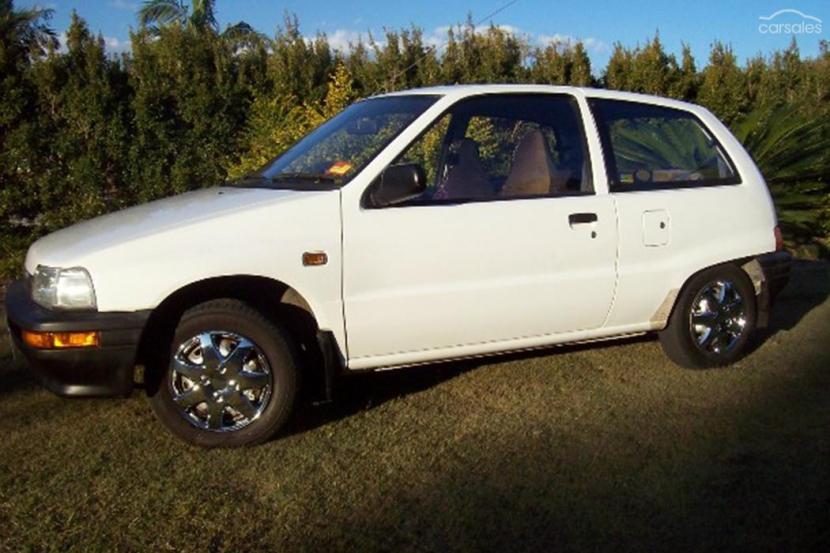
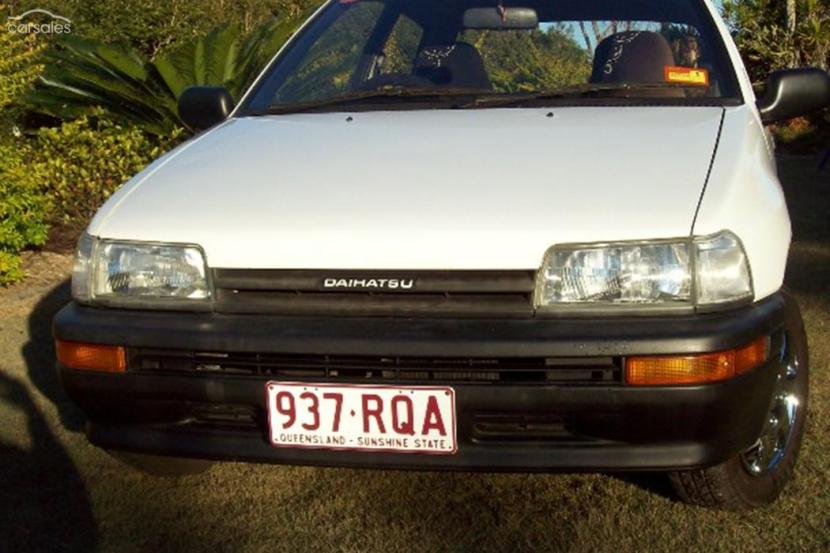
In 2011 I was wasting time on eBay, when I noticed a white 1990 Charade with just 140,000kms up for auction, priced at $450 (unregistered). How could I resist? It was a 2-owner car, being sold on behalf of someone who wasn’t computer literate (i.e. an older person). The car was in reasonable nick, but had scraped a power pole, so the panel on the front passenger side had been replaced with one from the wreckers (albeit a slightly different shade of white). I won the auction, and by adding $75 to the price, the seller delivered it to my home – all the way from the Gold Coast!
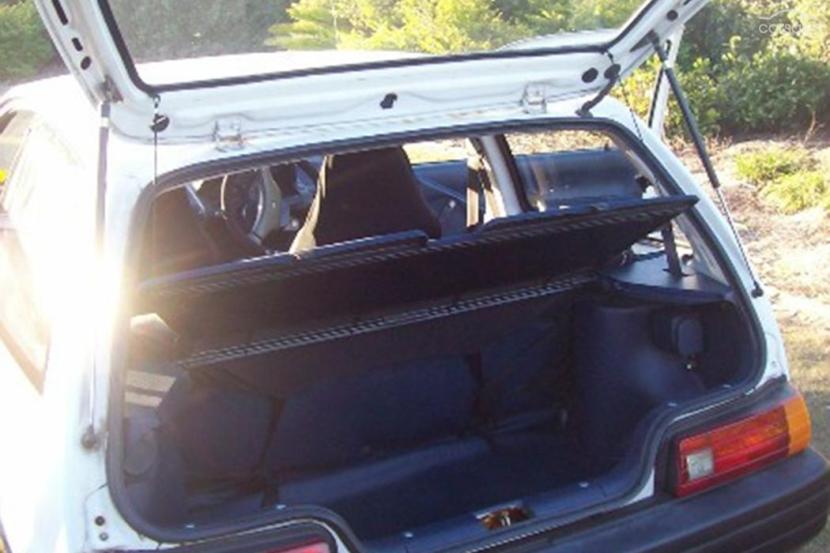
I had to spend a few hundred on new shock absorbers, to get the roadworthy. Plus, the rear hatchback had a habit of falling down, because the gas struts were gone. However I bought a couple of used ones from a wrecker very cheaply, and fitted them. Then, some floor mats and shiny wheel covers completed the makeover.
It was a good car to drive around for a few months, although it did have a bad habit: sometimes when starting it, the car would shout BRAAARP! and not turn over. A mechanic will know what causes this, I don’t – and despite this, I still managed to sell it for around $1,800 to a young first-time driver. That’s the sort of capitalism Mikhail made way for.
Long lost luxury, part 2
There’s a Polish expression my wife is fond of: “not my circus, not my monkeys”. It means someone else has invited trouble, and it’s not my problem. It’s a phrase I used a few times after she bought a 1999 Jaguar S-type on eBay.

Don’t get me wrong – there was nothing really wrong with the car, it was just that I was called on to repair and resell it when she decided she didn’t want to keep it. But, if you read this blog – you know I really didn’t mind.
1999 was the launch year for the Jaguar S-Type, based on the platform of a U.S. Lincoln LS/Ford Thunderbird as the company was owned by Ford at the time. The circular grille was really to keep the look of the car true to the original S Type of the 1960s, as it had a lot of empty space behind it. The 3-litre six cylinder engine in ours was also a Ford design. So even though it sounds very American, with its timber steering wheel and dash insert it still oozed British gentleman’s club. Being a shade of British Racing Green also helped.

The S-type had cost nearly $100,000 when new in 1999. In that same year we bought our second house for $105,000, so this was a true high-class luxury car, that was now 17 years old. Leather was in abundance, with an electric driver’s seat, climate control aircon.. and a Dolby cassette player with cassette drawer in the dash.
She happened on it while searching eBay for a car with a sunroof, to replace the family truckster we’d sold. It had 188,000 kms on the clock, a roadworthy and a month left on the rego – and it was up for auction, due to finish in a few hours, and currently bid at the starting bid of $5,000.
She showed it to me, and despite me airing my hesitations about buying an old British car, and going to the shops in a showy ride, she bid up to $5,100.. and the auction finished on that bid. So we now owned a “Jag” – bought sight unseen.

We picked it up and, as the owner had said in the ad, it was in good condition. So we were lucky there. We enjoyed the silent, smooth experience of driving it. However, after a few weeks of dealing with its considerable length and weight, and being left scared on a rainy day when it slid a little due to terrible wheel alignment, my wife decided it wasn’t for her. So it was time to sell.
Given that it had only passed a roadworthy less than 2 months earlier, you’d think it would be easy to have it reissued. However, when I got the same company to check it out (with a different inspector) a handful of problems were found. The inspector was surprised the previous guy hadn’t seen things like a broken fog light, worn tyre and perished suspension bushes .I was also surprised – and unhappy.
So after about $1,000 worth of work (plus renewed registration) the car was for sale on Carsales and Gumtree (where I felt it could attract a higher price than eBay). A family friend and even the next-door neighbour both made plans by buy it, but they fell through.

The eventual buyer looked at it 10 days after listing, and put down a $2,500 deposit after a short test drive – promising to pay the balance a couple of weeks later. Nearly TWO MONTHS later, we finally had the balance to make a small profit, he had a car he loved, and I had a monkey off my back.
 Classic and Clunker