Category: Clunker
Colt of old regret
Sam Colt founded a firearms company in the mid-1800s, and nearly 30 years later released his most famous revolver for the US Army: known as the .45 or, incredibly, the “Peacemaker”.
A little over a century on from that, Mitsubishi Motors Australia used its newly-acquired Chrysler plant in South Australia to produce a local version of the Japanese Mirage, as a Colt. It had a 1.4 or 1.6 litre 4-cylinder engine, with a bonnet that hinged at the front, not near the windscreen. Even when new, the Colt was a little ‘old skool’: it didn’t have fuel injection – it still had a carburetor – and this feature would come back to bite me.
My introduction to the car came in 2003, when a radio colleague was selling her 1988 manual brownie-bronzie one.

By Jeremy from Sydney, Australia – Mitsubishi Colt RB GL, CC BY 2.0, https://commons.wikimedia.org/w/index.php?curid=38109719
It had been her grandmother’s – then hers – but with a newer vehicle on the way, she offered it to me, unregistered, at the trade-in price she’d been offered: $500. Gran had sideswiped a garage door, so there was a minor dent on one wheel arch and some surface rust spots on the bonnet. Interestingly, the Colt had rotating “satellite” buttons on either side of the steering wheel, for the lights and wipers.

At the time I was driving a SEAT and my wife owned a big late-90s Mitsubishi Magna wagon, which would soon be needing some major engine repairs. So a plan was hatched: sell the Magna, give her the SEAT, and I would drive the Colt.
With the Colt registered, I cleaned the Magna engine and took it to a local caryard, which paid me a little over $2,000 for it. So I was already ahead by a grand or so!
About the same time, I was offered a TV job in Sydney. I’d move down there, rent a room, and fly home on weekends (these were the days of $29 Virgin Blue flights, which I bought in bulk).
So at dawn sometime around mid-May 2003, I packed some clothes, bedding, a plastic table and a stereo into the Colt, and drove south to new opportunities.
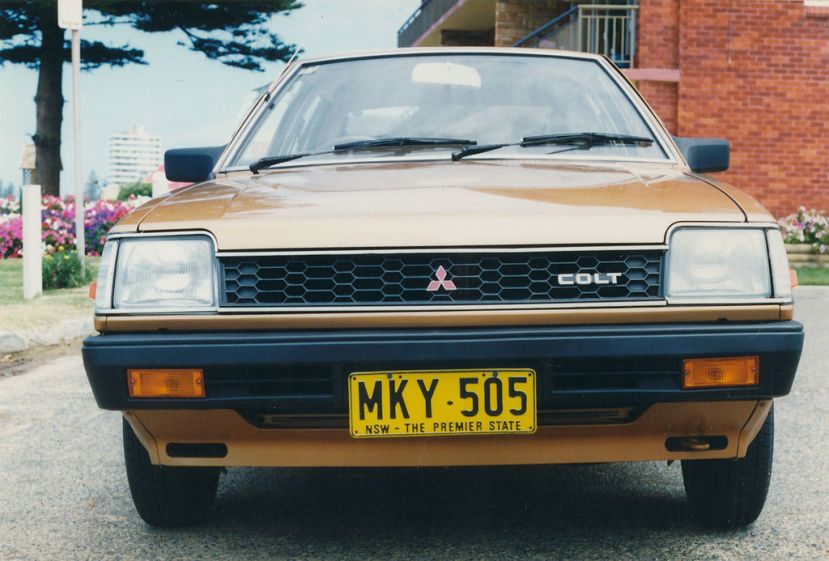
By Jeremy from Sydney, Australia – Mitsubishi Colt RB GL, CC BY 2.0, https://commons.wikimedia.org/w/index.php?curid=38109720
I arrived in Sydney at dusk, then bought some milk and cereal at a supermarket, and checked into a room – at an upmarket outer suburbs hotel – that had been arranged by my new employer, until I found a place to rent. The Colt was parked underground in the carpark.
The next morning, I ate my cereal out of a coffee cup with a teaspoon, and went down to the Colt. I turned the key, and the engine turned over, but wouldn’t fire up. I tried again and again. Eventually I called the NRMA, hoping that they would cover an RACQ member – which they did.
After just a couple of minutes, the mechanic had the car going, and asked “before you start the car, do you kick the accelerator pedal?”. With a fuel injected car like the SEAT, you didn’t even need to hit the pedal as it started, let alone before.
I later discovered that pushing the accelerator before starting a carby car resets the choke within the carb, getting it ready to cut back on air intake to make the fuel mixture richer for easy cold starting.
I believe the mechanic mentioned the butterfly valve in the carby could get stuck fast by a vacuum, on repeated starting attempts. I think he said the cooler weather in Sydney might have also had something to do with that (I’d had no starting problems in Brisbane).
He pointed out that in the owner’s manual, it does say to fully push the accelerator, before turning the key. I don’t think my Colt had the owner’s manual.

The Colt was fine to drive around Sydney, and leave at the airport every weekend. Although one Sunday, driving back from the airport – through the uphill section of the Harbour Tunnel – the car starting ticking or “pinging” badly (pre-igniting fuel), and losing power. I made it out OK, but then had some repair work done.
Before too long, the Colt was gone. My wife had been driving the SEAT, but with 2 young kids in tow she longed for rear doors on a car, instead of just 2 doors and front seats that had to be folded forward to put kids in the back. So during some holiday time I drove the Colt back to Brisbane, prepared the SEAT for the trip to Sydney, and traded the Colt in on a big 1990s Saab 9000 CS for the wife. With the Colt gone, I was the peacemaker.
The Monster Mash
If you tell someone to think of Frankenstein, they might visualise a large, murky-skinned body made up of parts, with a couple of bolts hanging off it. The classic Hollywood version is easy to imagine – even if it’s not factually correct. Mary Shelley never named the creature in her story – Frankenstein was the name of the doctor who created him.
It’s a similar process to how the Land Rover Discovery I used to own became known as “The Monster” – and it was also a body made up of parts, with the odd bolt hanging off it.

I’d been looking for a Land Rover 4WD when a mechanic friend found this 1996 7-seater Discovery 1, via eBay, in Bundaberg. One Saturday, late in 2013, we drove 4 hours north to look at it. The Disco had a worn manual gearbox, that protested loudly as we took it for a test drive. It also had some rust spots, but great air conditioning and a good 300 Tdi diesel engine, that had had some work done to the head recently. With a promise that the gearbox would be replaced with a reconditioned one at cost, I bought the Disco for $1600.
It still had a couple of days’ Victorian registration on it, and the owner was happy for us to drive it home. So the long trip south began – I drove the mechanic’s Disco home, and he drove mine – keeping the gearbox in 4th gear as much as possible, as it produced the least noise (due to a 1:1 drive ratio in 4th).
On arrival at home, my wife dubbed it “The Monster”, thinking I’d find it a derogatory term. I didn’t think it was monstrous at all – I loved the name and it stuck.
With “The Monster” now at home, plans were hatched to change the 1000kg gearbox ourselves, in my garage. The mechanic would do the work, and I would “assist” (i.e. grab spanners for him). It wasn’t long before we started this monumental job, one weekend.
After many, many bolts were undone, the old gearbox was freed from the vehicle, and hit the floor with a gigantic thud. The reconditioned gearbox was then moved underneath, but was too heavy for us to move up and into place, using jacks, bricks and firewood logs. So, on another day we borrowed a workshop crane, to do the job properly.

Crane pulling the gearbox up from within the cabin
After only a little swearing over the unwillingness of the new gearbox to move into place, the job was done and the truck could drive quietly.
However it did wait quite a few months to be finished off enough to pass a roadworthy. Now, I had my own off-road transport- and it was quite capable.

Land Cruiser Park river crossing
Underneath, the Discovery is very similar to the Land Rover Defender, has constant all-wheel-drive and a centre differential lock to make those low range gears even more grabby with the wheels. The diesel is very economical – while the V8 engine is only economical when compared to, say, a jumbo jet. That’s why they’re even more of a bargain.
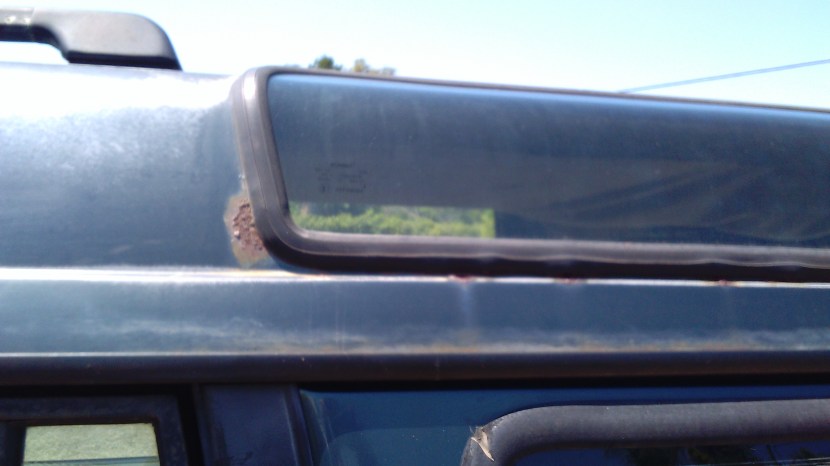
Mine suffered all the usual problems of a nearly 20-year-old Disco – rust around the Alpine windows in the roof, peeling clear coat from the bonnet paint, sagging roof lining, sagging seats – even the digital clock barely worked. However the engine kept clattering away happily, and it wasn’t my everyday drive.
After a couple years of ownership, with my wife driving my car each day, I decided that I now wanted a 4WD as my everyday drive, and a more luxurious one at that. So I decided to sell “The Monster” and bought a Range Rover.
It took 10 months, and a lot of price falls, before I found a buyer. I initially thought that a reliable – albeit rusty, ugly and old – diesel 4WD would fetch a lot more than it did. It sold, for slightly more than I paid, to a local man, who was going to take the engine out of it to fix up his own Discovery.
So just like Frankenstein’s monster, my Monster was ending up in pieces.. Although my experience had been more of a Monster Mash, than a graveyard smash.
Disco died, and so did this Corolla
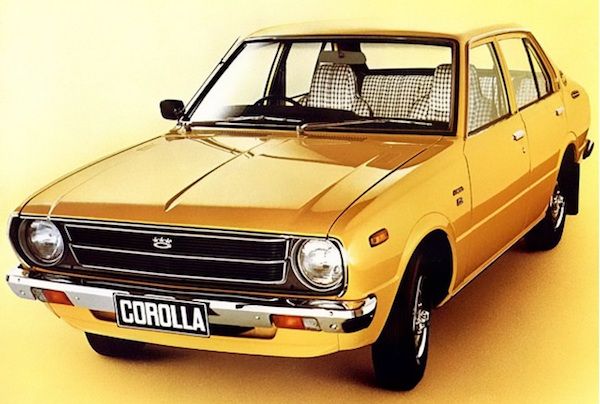
1977 was the time before disco “sucked”. That would come in mid-1979, with a radio promotion in the US where a DJ blew up a pile of disco vinyl in a packed Chicago baseball stadium, caused a riot and ruined the field for the next baseball game.
In ’77 the Toyota Corolla was “Stayin’ Alive” with a slightly updated model released, like a tepid dance floor remix. Translation: I think they changed the grille.
Unfortunately, rust was also alive in these models – in the welds either side of the back windscreen where it meets the boot, on the rear wheel arch welds and often in the front panels, where the mudflaps were screwed in behind the wheels.
Or, in my case, there was rust EVERYWHERE.
Enough bodyfiller putty to keep a daycare centre going for a year
I saw the yellow KE30 Corolla on the side of the road one Saturday, while being driven home from my casual supermarket job. To me, it had the looks: bright yellow paint, contrasting with the tyres, which were on Cheviot Turbo mag wheels. I was looking to buy my first car and I’d saved my pennies, with around $3,000 in the bank (a lot for a teenager in 1987). Wouldn’t you know it, the Corolla was about that amount.
I can still remember the name of the guy who sold it to me, with that lovely coat of yellow paint covering enough bodyfiller putty to keep a daycare centre going for a year. I KNOW WHERE YOU LIVE, PETER! Or lived, in 1987 when I bought it, at least..

The Corolla looked great for about 8 months and apart from running rough when it rained and water got into (perhaps) the distributor, and breaking the plastic door handles inside, it was a good, rear-wheel drive, economical car, equipped with the 1.2 litre 3K-C engine making 40kW.
It took me to high school, and my friends on adventures – including one adventure where the car’s cooling system failed on a Sunday, and we had to stop all the time to fill up the radiator and let the engine cool down. I didn’t have roadside assistance. But we had a good time, stopping at various service stations (which weren’t always open in those heady days of 1980s weekends) to use the tap.

But soon, bubbles started coming up around said back windscreen, around said mudflaps, wheel arches, on the bonnet above the battery, around the fuel cap, and in the bottom of all doors.. So in the end after trying (failing) to fix the holes myself, the car was taken (with holey panels very loosely screwed back on) to a local dealer to trade in on a newer Mazda 323.
Split up, like a pair of satin pants on an overweight dancer
The Corolla was probably split up, like a pair of satin pants on an overweight dancer. Disco was well and truly dead by 1988, and so was my 11-year-old Corolla. Rust sucks.
 Classic and Clunker